


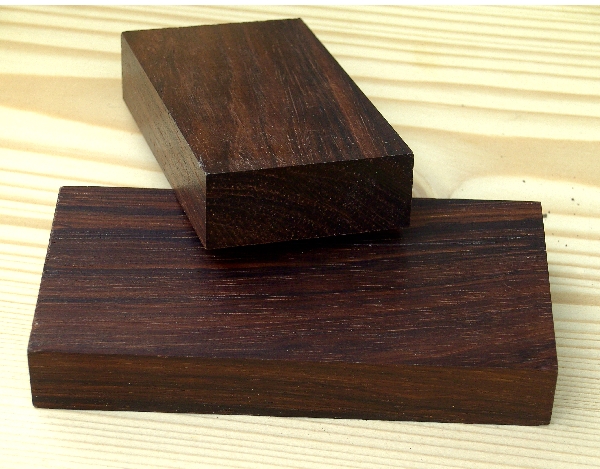
Padauk (Pterocarpus) is a genus of deciduous trees native to the tropics of South and Southeast Asia as well as Africa. Various species are traded under this name, the most significant being:
- Manila Padauk (Pterocarpus indicus) – Southeast Asia
- Burma Padauk (Pterocarpus macrocarpus) – Southeast Asia
- African Padauk / Muninga (Pterocarpus angolensis) – Central and East Africa
- African Padauk / African Coralwood (Pterocarpus soyauxii) – West and Central Africa
The wood is famous for its vibrant heartwood, which varies from brilliant coral red to deep violet-brown. It possesses high natural durability and is **resistant to fungal and insect attacks**. Once seasoned, it exhibits **excellent dimensional stability** and undergoes minimal warping.
Color and Light Sensitivity: The spectacular red hue of padauk is unfortunately extremely light-sensitive. Without specialized UV protection, the red fades under sunlight and shifts toward a plain brown. When applying surface finishes, a **sealing primer (isolating base)** is mandatory to prevent the natural pigments from "bleeding" into the varnish.
Unique Characteristics: A distinctive feature is the fine, light-grey efflorescence that may appear after processing. These are needle-like crystals of the compound **pterostilbene**, which can be easily wiped away. During sawing and sanding, the wood emits a characteristic acidic scent, often compared to the smell of pickled cucumbers.
Technical Notes: African species (Coralwood) are significantly heavier and harder than Asian varieties. Due to the high density, **pre-drilling** is essential for screw and nail connections. However, the wood is excellent for woodturning and can be polished to a high gloss.