


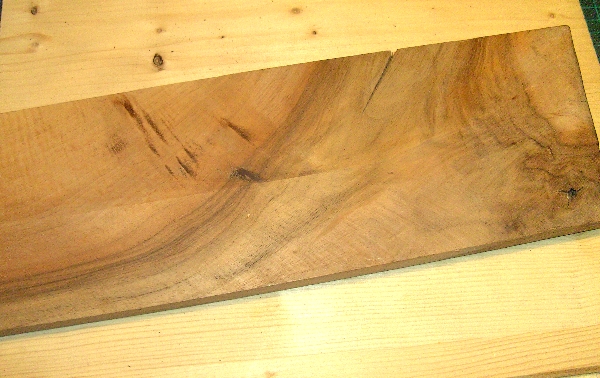
The English Walnut (Juglans regia), from the walnut family (Juglandaceae), is a classic heartwood tree. Its timber is considered one of the most valuable native precious woods.
Sapwood and heartwood differ significantly: the narrow sapwood is light-colored, ranging from grey-white to reddish-white. The coloration of the heartwood varies greatly depending on location and age—the spectrum ranges from matte grey and light brown to a deep dark brown, often permeated with dark streaks. The prominent annual rings give the wood a vivid, decorative figure.
Particularly sought after are the **Burl Clusters (Maserknollen)**: these develop in the root-stock transition zone through tuber-like thickenings and provide extremely wild-grained wood for exclusive veneers and woodturning projects.
Physical Properties: Walnut wood is medium-heavy to heavy, hard, and possesses excellent structural properties. It is particularly **resistant to bending** and, once seasoned, features **outstanding dimensional stability** (it exhibits minimal warping). While it undergoes significant shrinkage in its green state, it is dimensionally stable and durable when dry, provided it is not exposed to direct weather elements.
Processing: The wood is excellent to work with—both by machine and by hand. It is ideally suited for turning, carving, and profiling. Surface treatment with oils, waxes, or varnishes is straightforward and excellently highlights the grain ("firing up"). **Note:** Iron-based fasteners cause dark, almost black reactive discolorations when in contact with moisture (tannic acid reaction).
Special Applications: Due to its **high dynamic strength** and its property of hardly splintering during recoil, walnut is considered the best wood worldwide for high-quality **gunstocks**. Furthermore, it is used in high-end interior design, for pianos, and in fine furniture manufacturing.