


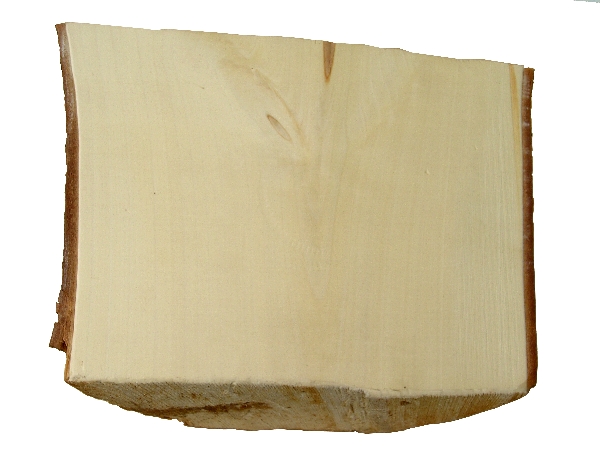
The Horse Chestnut (Aesculus hippocastanum), also commonly known as the European Horse Chestnut, is a fast-growing tree reaching heights of up to 30 meters and an age of 300 to 400 years.
Botanically, the horse chestnut is a **sapwood tree**, meaning there is virtually no color distinction between sapwood and heartwood. The timber features a pale, yellowish-white to light brownish hue. Its texture is very fine and uniform, while the grain in regular trunk wood appears rather plain and subtle.
Mechanical Properties: The wood is medium-weight and medium-hard. A remarkable anatomical feature is the almost mandatory **right-handed spiral grain** of the trunks. Despite this characteristic, the wood exhibits **good dimensional stability**; it undergoes minimal shrinkage and shows only a moderate tendency to crack or warp.
Processing and Applications: Horse chestnut is often underrated in woodworking. However, it is excellent for **turning, carving, and profiling**. Due to its light, neutral color, the wood absorbs stains and finishes very evenly.
Burl Wood: While the standard trunk wood is plain, **horse chestnut burl** is an absolute rarity and a thing of beauty. Its wild, pin-like structures are highly coveted by fine cabinetmakers and woodturners, used primarily for exclusive veneers, high-quality writing instruments, or decorative bowls.