


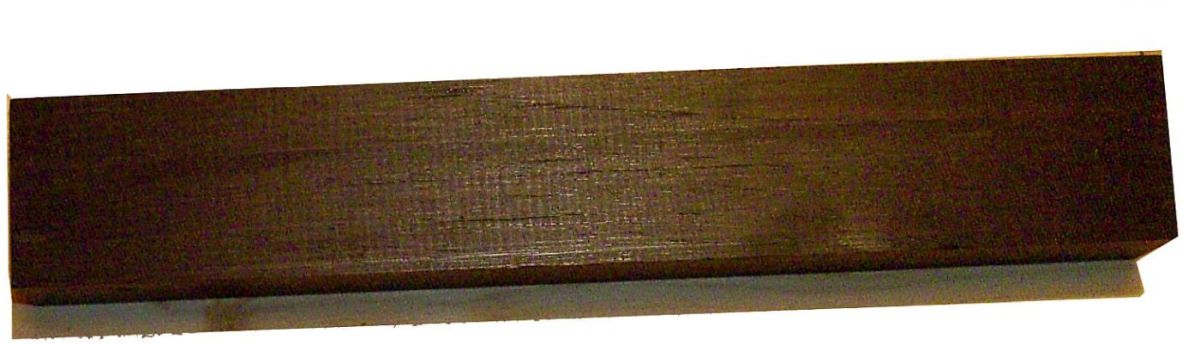
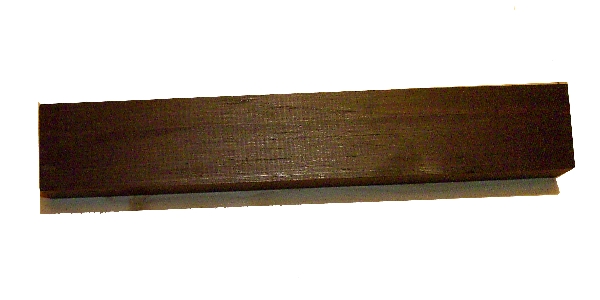
 African Blackwood (Dalbergia melanoxylon) is a deep dark brown to almost black hardwood of the rosewood family with a very fine grain (black, sometimes slightly violet). In its native regions, it is known as Mpingo.
It is primarily imported from Mozambique and Tanzania. In the past, it was erroneously traded as Senegal or Mozambique ebony, although it does not belong to the ebony family at all.
It was likely first brought to Europe by Portuguese traders at the beginning of the 16th century. Since then, it has held a permanent place in woodwind instrument making – mainly for clarinets, oboes, flutes, and traditionally the Great Highland Bagpipes.
The wood is famous for its absolutely outstanding acoustic properties. Due to its hardness and density, it produces a particularly overtone-rich and sharp sound.
Grenadilla is one of the heaviest woods – it is so dense that it does not even float.
The dark heartwood is surrounded by a bright yellow, quite thin layer of sapwood; the commonly used part of the tree is the heartwood. It has a very fine and homogeneous structure and feels smooth and slightly oily to the touch.
Due to its high density, it is impermeable to air. Its hardness allows for the turning or carving of exact and sharp edges. However, it is very difficult to process.
The surface can be polished to a high gloss. However, it virtually absorbs no oil and therefore cannot be "fired up" (enhanced). In a polished state, it often simply looks "black" – sometimes almost no longer like wood.
Its black-violet coloration and grain are unique and very subtle, revealing themselves only to a close observer after the final treatment.
The wood grows very slowly, yet consumption is steadily increasing, leading to supply shortages.