


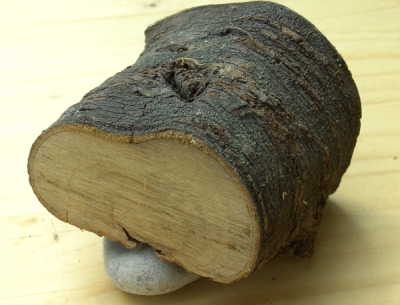
The Japanese Cherry (Prunus serrulata), also known as Oriental Cherry or Hill Cherry, is characterized by a very fine-pored wood with a homogeneous structure. Native to East Asia, it is widely appreciated in Europe as an ornamental tree, primarily for its striking pink blossoms.
The wood features a distinct separation between sapwood and heartwood. The narrow sapwood appears reddish-white-grey, while the heartwood is slightly darker, ranging from reddish-brown to yellowish hues. Occasional greenish streaks may occur. Under light exposure, the wood darkens characteristically, shifting toward orange or deep reddish-brown tones.
Grain and Structure: The annual rings are clearly defined. Earlywood vessels are arranged in a semi-ring-porous pattern, creating a decorative "cathedral" grain (Fladerung), while the darker latewood provides fine longitudinal streaking. A distinctive feature is the dense wood rays, which appear as lustrous **medullary rays (spiegel)** on radial surfaces. Planed surfaces exhibit a natural silky sheen.
Physical Properties: Japanese cherry wood is medium-weight, strong, and of moderate hardness, yet remarkably **tough and elastic**. It exhibits moderate shrinkage but is prone to warping during the seasoning process. Once dried, it offers excellent durability.
Processing and Fragrance: A unique characteristic emerges during thermal stress during processing: when sawing or sanding, the wood emits an aromatic, sweet fragrance strongly reminiscent of **roasted almonds**. It is excellent for carving and achieves a natural luster directly from the tool. Due to its fine structure, it is ideal for high-gloss polishing.
Applications: Beyond its use in high-end furniture (both solid and veneer), Japanese cherry is a preferred material for fine crafts and intricate woodturning due to its aesthetic appeal and ease of processing.
Below is an example of the intense figure found in a piece of **Japanese Cherry rootwood**: