


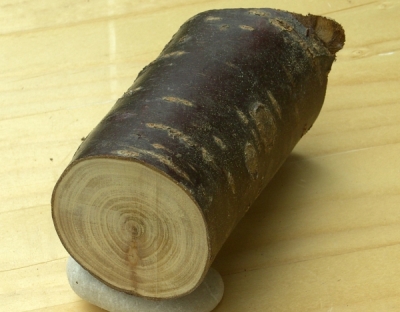
The wood of the Mirabelle (Prunus domestica subsp. syriaca), also known as the yellow plum, is a subspecies of the common plum (Prunus domestica). It is an aesthetically outstanding precious wood, typically featuring very fine, closely spaced annual rings, which indicates slow growth.
The sapwood is relatively light and narrow, while the heartwood takes on a significantly darker, often reddish-violet to brown coloration. However, the demarcation between sapwood and heartwood in the mirabelle is not always as sharply defined as in the common plum.
In its mechanical properties, the wood is very similar to that of the plum: it is **hard, very dense, and heavy**. This density allows for an excellent surface finish but requires sharp tools for processing. Due to the fine fiber structure, even the smallest details can be precisely crafted without the wood tearing out.
A critical factor is the drying process: Mirabelle wood is high in internal tension and **tends to crack and warp during drying**. It should therefore be seasoned very slowly, ideally with sealed end-grain surfaces. Once fully dried, however, it is very stable.
Applications: Since the mirabelle tree usually only reaches small trunk diameters, the wood is primarily used in **fine cabinetry**, **woodturning** (e.g., for exclusive writing instruments or boxes), and **musical instrument making**. It is also highly sought after for inlays and high-quality knife handles due to its lively grain and excellent polishing properties.
Despite its rarity in technical literature, wood craftsmen value the mirabelle for its decorative effects, which become particularly prominent after surface treatment with hard oil or wax.