


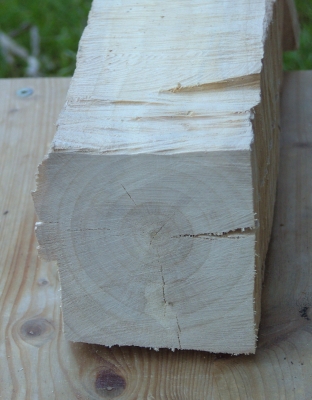
The Hornbeam (Carpinus betulus) is also commonly known as European Hornbeam. Its German name "Hainbuche" derives from the Old High German "Haganbouche," which points to its tolerance for heavy pruning (hedging). While its second name "Buche" (Beech) refers to its visual similarity to the Copper Beech, the Hornbeam is not closely related to the Beech family.
The wood of the hornbeam is whitish, which also led to the alternative name "White Beech." There are no color differences between the sapwood and heartwood. The annual rings are very difficult to distinguish, giving the wood a very uniform appearance. Hornbeam is truly one of the hardest native woods. The wood is rather plain and very light, almost white. It is exceptionally hard, heavy, and dense. Furthermore, it is considered tough and elastic. Its breaking strength is even greater than that of oak. However, the wood shrinks considerably and is prone to cracking and warping.
It is a heavy, very hard wood—said to be even harder than beech or oak. This has earned it the nickname "Ironwood." Due to its great hardness, the wood is used where heavy wear and tear occur. Today, it still plays a major role in piano manufacturing. Plane soles and other tools, butcher's chopping blocks, or billiard cues are further typical examples of its use. Despite its hardness, hornbeam wood is easy to process with all tools and machinery. With sharp saw blades and tools, cutting, planing, turning, and profiling pose no difficulties. The surface takes stains and polishes well but tends to yellow under sunlight. When in contact with iron and water, slight discolorations may occur.