

A Look Into the Workshop
When you take a look at carving knives you can see some fundamental differences:
1. On the one hand we have the so called carving chisels. This is a tool that looks a bit like a gauge with a wooden handle. The edge angle is somewhere between 20 and 35°, depending on the wood to carve and the type of wood.
- Flacheisen werden Balleisen genannt haben eine Gerade Schneide. Es gibt sie mit ein- oder zweiseitige geschliffener Fase geschärft. Als Fachbegriff auch unter Stich 1 bekannt. Die Schneide ist gerade oder abgeschrägt und entweder einseitig oder Zweiseitig angeschliffen.
- Hohleisen (Stich 2 bis 7) haben keine gerade Schneide, die in einem bestimmten Radius gebogen ist. Die geschliffene Fase liegt stets außen. Der Radius reicht von einer ganz leichten Wölbung, bis hin zur U-Form; hat der Radius die U-Form erreicht spricht man bei den Messern von Bohrern .
- Daneben gibt es noch etliche Sonderformen der Schneiden, wie beispielsweise die V-Form (=Gaißfuß), geschweifte oder gar kastenförmige Schneiden.
These chisels are available in different widths. the smallest chisel starts at 0,5mm and goes up to 70mm.
Regarding the length of the chisels we also can see differences. There are also straight chisels and some which are somehow bend - a little bit like a spoon. We can use it to reach unaccessible areas.
2. Besides this there are other knives which look more like knives we normally know.
The blades can have very different forms, depending on their use. For example for details or a Schaller-knife or a Canard-knife In most cases the difference is just the blade.
- Details
-
Also available:

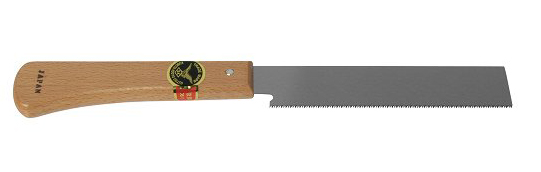
Noko Giri (japanische Säge)
Bei sogenannten Japansägen handelt es sich um Sägen, die aus einer jahrhundertelangen Tradition entstanden sind und sich über den langen Zeitraum entwickelt haben und immer wieder verbessert wurden. Holz war schon immer ein sehr wichtiger Bau- und Werkstoff in Japan. Seit jeher wurden Bauwerke aus Holz errichtet. Dementsprechend wichtig wurden Werkzeuge zur Holzbearbeitung und somit auch Sägen erachtet.
Europäische Sägen zerspanen - also zersägen - das Holz bei der Bewegung die vom Körper weggeht, also auf Schub. Ganz im Gegensatz dazu verrichten Japansägen ihre Hauptarbeit auf Zug, der Span wird also bei der Bewegung zum Körper hin abgetragen.
Bei dieser Art zu Sägen hält sich das Sägeblatt selbst gerade, weil es bei der Sägearbeit stets auf Spannung steht. Dieses Arbeiten auf Zug ermöglicht sehr dünne Sägeblätter und als Folge auch sehr schmale Schnittfugen. Bei europäischen Sägen wird während der Sägearbeit immer Druck ausgeübt und das Sägeblatt wird dabei immer etwas gestaucht. Durch die japanische Variante der Zugspannung, wird verhindert, dass sich das Sägeblatt bei Druck verbiegt.
Die Zähne
Zusätzlich haben die Zähne einer Japansäge noch eine ganz besondere Geometrie der Sägezähne aufzuweisen. Im Grunde unterscheidet man zwei verschiedene Varianten der Verzahnung bei japanischen Zugsägen. Man unterscheidet ob eine Säge vorwiegend quer zur Holzfaser oder längs zur Holzfaser sägen soll.
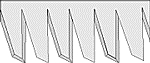 Bei der Trapezverzahnung (Zähne sehen einem verschobenen Trapez ähnlich) sind die Zähne wechselseitig angeschliffen. Diese Verzahnung ist vorwiegend für Querschnitte geeignet.
 Bei Längsschnitten wird die Dreiecksverzahnung bevorzugt (die Zähne sehen aus wie Dreiecke, wobei die Zahnteilung über die Länge des Sägeblattes variiert um den Anschnitt zu erleichtern). Durch die spezielle Geometrie erzielt man immer eine hervorragende Schnittqualität. Die Japansägen neigen nicht zum Verkanten oder Verwinden bei der Sägearbeit.
Seit einiger Zeit werden diese Sägen auch bei uns zunehmend bekannter und immer häufiger werden Sägen mit Wechselblättern (nicht mit festem Stiel) verwendet.
Die Gründe hierfür sind einfach: Es ist eine vornehmlich finanzielle Frage. Zum Einen ist jemandem der darin nicht ausgebildet ist, kaum möglich eine Säge zu schärfen, schon gar nicht, wenn es sich um eine Japansäge mit völlig anderer Geometrie handelt. Zum Anderen sind die speziell gehärteten Zähne der Säge so hart, dass eine herkömmliche Feile daran die „Zähne ausbeist“ – die Zähne der Säge sind meist härter als die Feile.
- Details
-
Also available:
Japanese water stones are available as natural and as synthetic stones .
Today mostly synthetic stones are used , in which the grinding bodies are bound in different ways and resolved during the grinding process .
The different types of stones by grain size:
- Schruppsteine (grain size : 80 - 240) : used for grinding and shaping of scratches and defects , ie for repair - or for rough shaping.
- Grinding stones ( grain size: 800-2000 ) : they are used to the "basic clarity" to produce a cutting edge
- Polishing stones (grain size : 4000-12000 ) to the sharpness produced by the grinding stones to further refine and at the same time to remove the last scratch of grinding in order to obtain as flawless and smooth cutting .
The grain :
It is really important to know that the grain size in Japan has a completely different standard than in Europe , ie a grain- 1000s in Japan by no means corresponds to a 1000 grain in Europe. A Japanese stone with a grain J8000 (Japanese JIS standard) is about a European F2000 (European FEPA standard) .
Worth knowing seems to me also that the grain sizes are standardized only up to 8000 grain in Japan! Everything beyond this is just believe in the manufacturer !
Usage:
Before use, the water stones have to be put in water for several minutes so that they completely can soak in water. This is necessary to ensure that enough sharp abrasive particles can be loosened during the grinding process. Even during the grinding operation, water has to be added to the stone repeatedly. They should really not "run dry".
Even the Japanese stones are not quite as hard as the European . This means that it is relative easy to get a notch in the grindstone during the sharpening process.
- Details
-
Also available:
1. hollow grinding
The hollow grinding or concave cut is is really very sharp, but the blade is weakened, it is very thin. Razor blades are sharpened with that grind, but also some "alround knifes" where the focus is on the cutting.
Regarding razor blades it is important that they are really aharp and thin. A hollow grinded blade can by no means used for chopping or cutting under high pressure.
The hollow grind is mostly used for cutting tools and weapons.
However, the blade is weakened and has a lower stability with this kind of cut. This form of the carving represents a geometry of cutting that has come into existence by grinding.
This cut may be a year. Because of this special way of sharpening the blade get thinner and thinner. This cut gives a high sharpness, but, as already mentioned decreases the stability of the blade. Moreover, this is not as robust. Therefore, the hollow ground is used to cut soft material.
There are 08/15-Sharpening tools like those mostly seen in kitchens or where cooking knifes can be sharpened. These devices mostly have two "rolls" (rotating or still) where the blade can be drawn in a 90° angle. This creates a new sharp edge very fast. But this sharpness creates a kind of " hollowing out" and the edge is very thin and frgile. In most cases this does not make sense for knifes used in the kitchen. When you use it normal the edge will break and you have to sharpen it again very fast, because it is vulnerable for breaking.
2. spherical grinding (spherical cut)
The crowned cut (convex edge) is also known as "Eisenhauer cut" (comming from special swords of the medieval times) or "Solingen cut". It looks like two arcs coming together. The benefits of this cut is a quite good sharpness together with a good stability of the cutting edge. This cut can be found in many of these kitchen knives (European knifes). The biggest advantage is the stability and durabilty of the edge .
A clear advantage of this type of cut is that the blades after a blow in solid materials ( wood, bone ) can not jam or jam so easily.
This is due to the initially quite sharp angle in the vicinity of the cutting edge. A little later the materialis getting thicker, which contributes to the robustness of the edge. As I said, the spherical ground does not led to an outstanding sharpness, but offers a very high stability of the cutting edge. Is very suitable for chopping tools, such as an ax.
However, a spherical section can also occur unintentionally due to an improper grinding of the blade.
3. surface grinding
This is the simplest form of cut . Stable than the hollow ground but not quite as sharp. The surface grind is a good compromise between the edge of the hollow grinding and the stability of the spherical grinding.
Knife with this finish, they have a unique sharpness. The sharpness of the blades is given by the fact that they lie flat on a stone and then sharpened on each side. In this process, a slight oblique procedure should be performed on the stone.
It is relatively easy to resharpen blades with this cut .
4. single sided grinding
The single-sided-cut can be found by most of the Japanese knives and a plurality of tool cutters used . it gives a very strong blade and is very easy to regrind. The grinding angle varies depending on the application . In America, it is also called "Chisel Grind" . Through this cut results in a sharp and quite stable cutting.
- Details
-
Also available: